1973 – Oldham Athletic in the FA Cup
The biggest day in our history
Formby fans had a banner that said ‘Tommy Cheetham walks on water’. The club legend had been with us for 18 months and would become that season’s top scorer. Butterworth had joined the club six months after Cheetham and, between the two of them they accounted for the vast majority of our
goals.
Ambrose ‘Amby’ Clarke was an indefatigable wing half who was new to the club. A Bootle lad, he’d been on Everton’s books in the glory days of the early
60s but never made his mark. Aged 20, he moved to Southport in January 1966, winning promotion to the Third Division with them at the end of that season. After being a virtual ever-present at Haig Avenue he moved to Fourth Division Barrow in the close season of 1971. Amby was also a regular there, turning out for 46 appearances in 1971-72, but the Bluebirds were relegated out of the League, at which point he moved to Skelmersdale United for a year.
He signed for Formby as captain over the summer of 1973 but a ligament injury kept him out for much of first two months. He had rejoined at the start of October and was by now integrated into the team. He stayed at Brows Lane until 1977 (the seemingly obligatory quality 1970s Formby player’s brief spell at Burscough notwithstanding) and was always one of the first names on Bryan Griffiths’ selection sheet.
November 1973: Anticipating the month of Movember by 40 years, several key Formby players try to look natural for this publicity shot. From left: Johnny Moore, Tommy Cheetham, Johnny Butterworth, Amby Clarke, Kenny Hulme & manager Bryan Griffiths
——————————–
 It’s often said that everyone remembers where they were and what they were doing on November 22nd 1963 when they first heard the news from Dallas, Texas, apparently official, that US President John F Kennedy had been assassinated.
Fast forward ten years and two days to November 24th 1973 and ask anyone living in Formby what they were doing. Chances are most won’t have a clue. But if you say it was the day Formby FC played Oldham Athletic in the First Round Proper of the FA Cup, they will say ‘I was there’.
And so they were. In their thousands. For this was the biggest day in Formby FC’s long and inglorious history.
What was Formby like in 1973? Ted Heath was Prime Minister and leading the country towards a three day week. There was a royal wedding as Princess Anne married Mark Phillips. It was alright to like Gary Glitter and lots of people did because his single I Love You Love Me Love was number 1. You had to walk up to Quirk’s on Ryeground Lane to buy it though.
You could still shop at Tesco, but only in a small one in the Village. Instead of Clubcard points shoppers collected Green Shield Stamps. Bill Shankly was in his last season as manager of Liverpool FC and would lead them to FA Cup glory. But that was only after Formby FC had been knocked out.
The squad

November 1973: Anticipating the month of Movember by 40 years, several key Formby players try to look natural for this publicity shot. From left: Johnny Moore, Tommy Cheetham, Johnny Butterworth, Amby Clarke, Kenny Hulme & manager Bryan Griffiths
That season Formby were a mid table side in the Cheshire League playing in blue and yellow striped shirts and blue shorts.
Formby fans had their favourites among the team, as evidenced by a banner that said ‘Tommy Cheetham walks on water’. The heavily sideburned club legend had been with us for 18 months and would become that season’s top scorer. Johnny Butterworth had joined the club six months after Cheetham and, between the two of them they accounted for the vast majority of our goals.
Ambrose ‘Amby’ Clarke was an indefatigable wing half who was new to the club. A Bootle lad, he’d been on Everton’s books in the glory days of the early
60s but never made his mark. Aged 20, he moved to Southport in January 1966, winning promotion to the Third Division with them at the end of that season.
After being a virtual ever-present at Haig Avenue Amby moved to Fourth Division Barrow in the close season of 1971. He was also a regular there, turning out for 46 appearances in 1971-72, but the Bluebirds were relegated out of the League, at which point he moved to Skelmersdale United for a year.
He’d signed for Formby as captain over the summer of 1973 but a ligament injury kept him out for much of first two months. He had rejoined at the start of October and was by now integrated into the team. He stayed at Brows Lane until 1977 (the seemingly obligatory quality 1970s Formby player’s brief spell at Burscough notwithstanding) and was always one of the first names on Bryan Griffiths’ selection sheet.
Jack Connor was a 39 year old centre back who’d played in the top flight for Huddersfield Town in the 1950s. He was there under Bill Shankly in the legendary 1957 Charlton Athletic v Huddersfield match where the visitors were 5–1 up with less than half an hour remaining yet lost 7–6. They were the first, and still the only, team to score six goals in a professional football match and be on the losing side. He’d settled in Formby and joined the club just ten weeks before the Oldham match.
The campaign begins
Though they were a formidable squad, their FA Cup run got off to an inauspicious start with a 1-1 draw away at Burscough. It took a 92nd minute equaliser from Tommy Cheetham to keep Formby in with a chance. The replay took place under the Brows Lane floodlights and, in what the Formby Times described as their ‘finest attacking display of the season’, Formby took Burscough apart with a stunning 4-1 victory.
When the draw for the second qualifying round was made Formby had to travel to the home of Lancashire Combination side Darwen. This was another tight game but the Squirrels edged it 1-0 with a Johnny Butterworth goal.
The third qualifying round finally saw Formby drawn at home, this time against local rivals Ormskirk. This, too, was a closely fought game that Formby won 1-0 with another Tommy Cheetham goal.
Such was the scale of Formby’s record breaking progress that they started to make front page news. In their edition of 24th October, the Formby Times reported that Formby faced a tough battle against Northern Premier League sides Goole Town or Bradford Park Avenue.
It turned out to be Goole Town that came to Brows Lane. Tommy Cheetham hit the bar in the 13th minute, before Johnny Butterworth scored on the half hour. A second half goal apiece from the dynamic duo meant Goole were duly dispatched with a 3-0 drubbing.
But the competition got tougher at every stage, and when the draw was made for the FA Cup First Round Proper all Formby could hope for was a home tie against Football League opposition. And they got it, in the shape of Oldham Athletic. Formby stiffened itself for its biggest invasion since the Vikings landed in 960AD.
The big day approaches

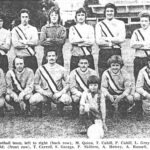
Monday 19th November 1973: Are they actively trying to mismatch their kit? Back row L-R: Bryan Griffiths (manager), Tommy Cheetham, Kenny Hulme, Alan Leicester, captain Ray Green, Jack Connor, Ray Stanley, Dave Elder, Leary (trainer). Front: Amby Clarke, John Price, Johnny Moore, Johnny Butterworth, Stan George, Gordon Iverson
Such was the clamour surrounding the game that police advised Formby chairman Trevor Hitchen that the game should be all-ticket affair limited to 4,500 fans.
Brows Lane had to be made suitable to handle such a crowd. Bulldozers were brought in to slope the ground so spectators could see over those in front of them. A temporary stand was erected and mobile toilets installed. Ticket prices were to range from 50p to stand, up to £1.50 to sit in the temporary stand.
Cup fever gripped Formby in the week leading up to the big game. Even Granada TV’s Kick Off programme visited Brows Lane to report on preparations for the match. Local shopkeepers expressed concern once it became known that up to 1,000 Oldham fans were expected to make the trip.
The front page of the Formby Times described the number of fans expected to attend as a ‘soccer invasion’. It’s hard to imagine a rampant herd of three star jumper, brown Air Wear clad, long haired woollybacks from the foothills of the Pennines popping into Patrice newsagents for ten Woodbines or into Byrne and Son’s for a frilly dress shirt.
The Formby Times ran a feature on the players and many businesses printed good luck messages to the team. Perhaps the most appropriate was from the proprietors of Arena Sports on Old Town Lane. It said;
Arena Sports join in wishing Formby FC all the best in Round 1 of the F.A. Cup.
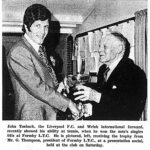
John and Emlyn look forward to a third round meeting at Anfield !!!
Yes, the proprietors of Arena Sports were Liverpool FC’s star striker John Toshack and captain Emlyn Hughes.
So who were Oldham Athletic? They were managed by Jimmy Frizzell, a no nonsense Scot who had played over 300 matches for the club. The season they played Formby they went on an incredible run of ten consecutive league wins, still a club record, that laid the foundations for their Third Division title triumph.
Perhaps their most famous player was Andy Lochhead who had enjoyed considerable success with Burnley, Leicester (with whom he appeared in the 1969 FA Cup final) and Aston Villa before moving to Oldham in 1973. They were his last Football League club.

Formby v Oldham Athletic, 24th November 1973. A crowd six deep, a bar scarf tied round a wrist, an arlfella in a flat cap, someone not only sat on shoulders but with index fingers pointing suggesting they’re singing, people mid shout and all three of the Formby FC buildings in shot too; the snack bar, the 1960s clubhouse and, in the foreground, Brows Lane’s unusually sited main stand that was behind the South End goal.
Kick off
Formby certainly made the opposition play, and on the half hour Butterworth brought the crowd to its feet when he headed inches over the top from Cheetham’s cross. Nobody expected Formby to win, given that they played in the same league as Oldham’s reserves side, but with the game remaining goalless at half time the pie queue must have had plenty of Squirrels fans dreaming of glory.
It was not to be. In the 54th minute George Jones broke the deadlock, and eight minutes from time he struck again, sealing Formby’s fate.
The Formby Times reported that:
‘The Squirrels went out with their heads held high. For although the scoreline had an air of inevitability, the match certainly didn’t. Athletic were disappointing. And I’m prepared to wager that any stranger who walked into Brows Lane on Saturday would have found it very difficult to distinguish between the Cheshire League and Football League sides.
Formby had the lion’s share of the play in the first half. Playing with their backs to the strong, blustery wind, their main attacking play was to pump long balls into the heart of the Athletic defence, for the eager Butterworth, Cheetham and Moore to chase….
Athletic – using Lochhead as a target man and two orthodox wingers to stretch the Squirrels’ defence – took command with some neat, creative football. But it still took them 85 minutes to sew up the game. It was not classic, but a fiercely fought contest. The packed ground, the spectators in the trees and the chanting of rival sets of supporters gave the occasion a spine tingling spirit which only FA Cup ties can generate.’
The Oldham Evening Chronicle was altogether less generous, saying:
‘Athletic overcame the triple challenge of Formby at cramped and claustrophobic Brows Lane The threefold challenge actually had the Formby team cast in a very minor role. Chief among Athletic’s enemies were a rough and uneven surface and a teasing torment of a wind that blew so many of the game’s better moments off course.
It was the conditions rather than the opposition that held Athletic back throughout an untidy and totally uninspired first half. But once they had the measure of the wind and had mastered the unpredictable bounce of the ball, Athletic assumed a command that was total.’
Afterwards
Oldham got as far as the 4th round of the FA Cup, at which point they were dumped out by Burnley.
It was a season of cup achievement for Formby. This had been their twelfth of 21 cup ties and they would go on to have their all time best FA Trophy run too, as well as finishing 7th in the Cheshire League. It would be nearly five years before they lifted any silverware. 1973 remains their best performance in the FA Cup.
– Adrian Cork